
Key takeaways
- Instructional design services typically come in three engagement levels. The right one depends on how complete your content is and how much of the design work you want a vendor to take on.
- Level 1 (content review) is for organizations whose internal teams produce their own storyboards and want a professional review before development. The vendor reviews and recommends; the client edits.
- Level 2 (content editing) is for organizations with finalized content that needs to be transformed into interactive learning. The vendor adds interactivity to client-provided content; the structure stays as-is.
- Level 3 (full instructional design consulting) is for projects where the design work itself is the primary need. Needs analysis, subject matter expert interviews, and full storyboard creation are included.
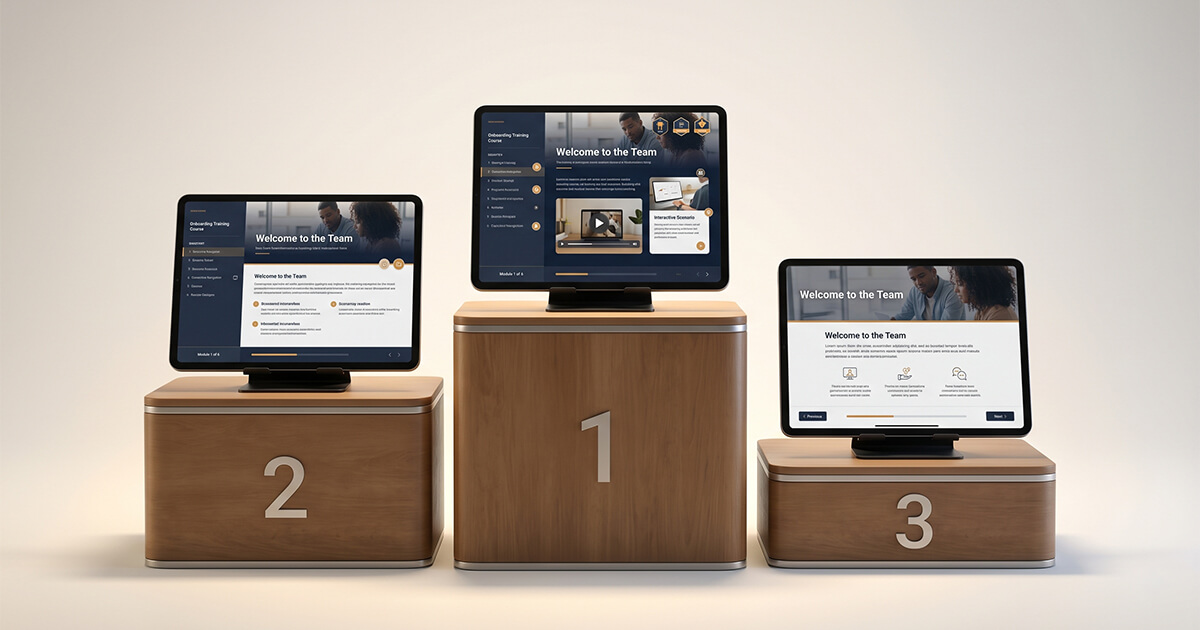
- The three levels aren’t a hierarchy. They’re different services for different situations. Choosing the wrong level wastes money in either direction: paying for Level 3 when Level 1 would do, or paying for Level 1 when the project actually needs Level 3.
“Instructional design services” is a broad term, and what’s included varies significantly across providers. One vendor’s instructional design service includes needs analysis, subject matter expert (SME) interviews, and a full storyboard. Another vendor’s instructional design service is reviewing a client-built storyboard and offering suggestions. Both are legitimate offerings, and both get marketed under the same name.
This guide walks through the three engagement levels you’ll typically find in the market, what each one actually includes, what’s required from the client at each level, and how to scope the right one for your situation. By the end, you’ll have a clear sense of what to ask for when comparing vendors and how to avoid paying for work you don’t need (or paying too little for work you do).
For the broader question of what instructional design is and what an instructional designer does, our guide to instructional design covers the discipline itself. This guide focuses specifically on what gets sold under the heading of services.
What instructional design services actually include
At its core, an instructional design service is professional design work for a training initiative. The actual scope varies by engagement level, but the work falls somewhere on a spectrum from “review what we built” at one end to “build it from scratch with us” at the other.
A few elements are common across most instructional design service engagements:
- Some form of content evaluation: Whether reviewing a finished storyboard or analyzing scattered source materials, the engagement starts with the vendor understanding what’s already in place.
- Application of instructional design principles: Learning objectives, sequencing, practice design, and assessment strategy. The depth of involvement depends on the level.
- Some form of deliverable handoff: Review notes at one end, full storyboards at the other.
- SME collaboration to varying degrees: Light touch at lower levels, deep involvement at higher levels.
What’s not typically included in an instructional design service:
- Course development. That’s eLearning development, a separate service.
- Media production (video, voiceover, custom animation). Usually a separate service.
- Project management of multiple vendors. Some agencies bundle this; many don’t.
- LMS administration or deployment. Almost always handled by the client.
A common buyer mistake is assuming “instructional design services” includes everything from analysis through finished course. Some providers do bundle that comprehensively; many don’t, and the cost difference is significant. Always read the scope carefully.
The three engagement levels
Most instructional design service offerings fall into one of three engagement levels. The names vary across providers, but the structure is fairly consistent in the industry.
| Level 1: Content Review | Level 2: Content Editing | Level 3: Full Instructional Design Consulting | |
|---|---|---|---|
| You provide | A finished storyboard | Final, slide-ready content | Source material and SME access |
| Vendor delivers | Review notes and recommendations | Interactivity built into your content | Needs analysis through full storyboards |
| Best fit when | Your team has design capacity and wants expert review | Your team writes well and wants professional interactivity | The design work itself is the primary need |
| Common pitfall | Sending a draft expecting iteration | Trying to revise content mid-engagement | Underestimating SME time commitment |
The detail behind each level follows.
Level 1: Content Review (review-only)
A Level 1 engagement is professional review and feedback on a fully complete storyboard or course outline that the client has built themselves. The vendor reviews the work for instructional quality, consistency, accuracy, learning objective alignment, and overall flow, then provides recommendations. The client makes the actual edits.
What the vendor provides:
- Review notes flagging inconsistencies, gaps, or issues with flow
- Recommendations for improving learning objective alignment
- Suggestions for interaction or assessment design where appropriate
- Quality assurance (QA) feedback on instructional rigor
What the client provides:
- A finished storyboard or course outline ready for professional review (not a draft, not a work-in-progress)
- The internal capacity to incorporate feedback and produce the final approved version
Level 1 is the right fit for organizations with internal instructional design capacity. The client team has the skills and bandwidth to design their own training but wants an experienced second set of eyes before development begins. It’s also the lowest-cost engagement of the three, because the vendor isn’t doing the design work itself.
The most common reason Level 1 engagements fail: the storyboard provided isn’t actually finished. When the client sends a draft expecting collaborative editing, both sides end up frustrated. A vendor offering a Level 1 engagement is offering review, not collaborative iteration.
Level 2: Content Editing (interactive-ready content)
A Level 2 engagement transforms client-finalized content into interactive learning. The instructional structure and the content itself are already settled. What the vendor adds is interactivity: knowledge checks, quizzes, micro-instructions to learners, and the design of interactive elements. The vendor isn’t re-architecting the course or rewriting the content. The work is making finalized content into an engaging experience.
What the vendor provides:
- Addition of interactive elements (knowledge checks, branching where appropriate, quizzes)
- Micro-text design (learner instructions, transition copy, assessment feedback)
- Transformation of slide-based content into eLearning-ready format
- Light instructional refinement where issues surface during the work
What the client provides:
- Slide-based content that is complete, approved, and ready for transformation
- Final narration scripts (for narrated courses)
- All content already organized into the slide structure the course will use
Level 2 fits organizations with strong internal content creators who produce well-written, slide-ready content but want professional transformation into interactive eLearning. It’s a focused engagement that doesn’t ask the vendor to rethink the course design, only to elevate it.
Where Level 2 goes wrong: when the content provided isn’t actually final. If the client expects to revise the underlying content during the engagement, that’s a Level 3 engagement, and the cost will be different. Pretending otherwise leads to scope creep on the vendor side and budget surprises on the client side.
Level 3: Full Instructional Design Consulting
A Level 3 engagement is the full instructional design discipline applied from the start of a project. The vendor handles needs analysis, learner profiling, subject matter expert (SME) interviews, content structuring, learning objective development, and full storyboard creation. The client provides the source material (in whatever shape it’s in) and access to subject matter experts.
What the vendor provides:
- Needs analysis to clarify the actual performance gap and whether training is the right intervention
- Learner profile development
- Curriculum or course architecture (depending on scope)
- SME interview facilitation and knowledge extraction
- Content structuring and narrative development
- Engagement strategy mapping (what kind of interaction, where, and why)
- Detailed storyboards ready for development
What the client provides:
- Access to subject matter experts (typically 2–3 sessions of 60–90 minutes per major topic)
- Existing source materials (documents, recordings, presentations, institutional knowledge)
- Stakeholder availability for review and approval
- Clarity on the business outcome the training is supposed to drive
Level 3 fits projects where the design work itself is the primary value. Content may be scattered across multiple sources, may not exist in any organized form yet, or may need significant restructuring. The client may not yet have a clear instructional plan, just a business problem and some source material.
Level 3 engagements are the most involved and the most expensive of the three. They’re also where the work an instructional designer does adds the most value, because the design choices being made aren’t being retrofitted onto existing structure.
How to choose the right level
The right level depends on the answers to a few specific questions about your project:
- Do you have a finished storyboard or just source material? Finished storyboard suggests Level 1. Source material suggests Level 3.
- Is your content slide-ready or still in document/source form? Slide-ready suggests Level 2. Document-form suggests Level 3.
- Does your team have instructional design capacity in-house? If yes, Level 1 or 2 are realistic. If no, Level 3 is usually the right starting point.
- Is the content’s structure settled, or is restructuring still needed? Settled structure means Level 2 might fit. Open structure means Level 3.
- Are SMEs available to be interviewed, or has knowledge already been captured? Knowledge captured suggests Level 1 or 2. SMEs available but knowledge not yet captured suggests Level 3.
A common mistake is matching the level to budget rather than to project need. A Level 1 engagement on a project that actually needs Level 3 produces review notes that don’t address the real issues, because the underlying design has too many gaps for review-stage feedback to fix. Similarly, a Level 3 engagement on a project that just needs Level 1 burns budget on work the client could have done internally.
If you’re unsure which level fits, the safer move is usually to ask vendors which level they’d recommend based on a brief description of your situation. A reputable vendor will tell you the truth, even if it means a smaller engagement.
What to expect from a typical engagement
A few practical considerations for any instructional design service engagement, regardless of level.
The work moves through review cycles. Most reputable instructional design engagements have at least two review cycles built into the storyboard phase: an initial draft, feedback, a revised version, and final approval. Some vendors structure this more formally as a “2x2” model (two review cycles for storyboards, two for build). Others operate more iteratively. Either approach is fine, but make sure the review structure is defined in the SOW so feedback expectations are clear on both sides.
Subject matter expert (SME) availability is the most common bottleneck. Even at Level 1, where the storyboard is already complete, SME availability matters for clarifying questions during review. At Level 3, SME availability is the project’s pace-setter. If your SMEs are unavailable for two weeks, the engagement effectively pauses for two weeks. Plan for this realistically.
Source files and ownership should be clarified upfront. The output of an instructional design engagement is intellectual property: review notes at Level 1, storyboards at Level 3. Both should belong to the client at delivery. Some vendors retain rights or require ongoing licensing fees, and that’s worth flagging early in the conversation.
Pricing models vary. Fixed-bid contracts are common at Levels 1 and 2 because the scope is clear. Level 3 engagements often work better with retainer or points-based pricing because the scope evolves as the project surfaces information. Ask how the vendor handles scope changes mid-engagement before signing anything.
How instructional design services connect to other services
Most instructional design service engagements are part of a larger training project. Understanding where instructional design fits in the broader workflow helps clarify what’s in scope and what isn’t.
A typical project flow:
- Curriculum-level decisions, if applicable: What courses exist, how they connect. Done by curriculum design or curriculum consulting, not instructional design.
- Course-level instructional design: The work this article is about. Produces storyboards or design specifications.
- eLearning development: Building the course in an authoring tool. Produces a SCORM-ready or web-deployable course.
- Media production: Video, voiceover, custom animations, graphic design. Often runs in parallel with development.
- Quality assurance (QA) and deployment: Testing, LMS integration, launch.
When a vendor offers “instructional design services,” they’re typically describing work in step 2. Some agencies bundle steps 2–5 under broader contracts. Some specialize in just step 2 and hand the storyboard to a separate development team. Both models are valid; the right one depends on whether you want a single vendor or multiple specialized partners.
For more on the curriculum-level work that sometimes precedes instructional design, see curriculum consulting. For evaluating providers across all of these stages, our guide to instructional design companies walks through how to compare vendors and what to ask in a discovery call.
Where Custom Learning fits
Neovation Custom Learning is your full-service, instant L&D capacity, providing expert instructional designers, eLearning developers, and project managers who turn your organization’s raw expertise into interactive, scalable custom training. We offer all three engagement levels described above: Level 1 review for clients with strong internal teams, Level 2 transformations for clients with slide-ready content, and Level 3 full consulting for projects starting from source material.
For Level 3 work, we use the Custom Learning Points model rather than fixed-bid contracts. Design projects tend to evolve as the work surfaces information, and points let the engagement absorb that evolution without contract renegotiation. For Level 1 and Level 2 work, fixed pricing is usually a reasonable fit because the scope is more contained.
If a custom engagement isn’t the right shape for your project — because the team has in-house design capacity, a freelance instructional designer could handle the scope, or the work is small enough to keep internal — those are valid options. Contact us when you’d like to discuss which level fits your situation, or browse our case studies to see what these engagements look like across different industries and complexity levels.
Frequently asked questions
What’s the difference between instructional design services and eLearning development?
Instructional design services produce the design itself: the learning objectives, structure, sequencing, practice activities, and storyboards. eLearning development is the work of building the course in an authoring tool based on the design. Most successful projects involve both, often with the same vendor, but they’re different services with different deliverables. Asking for "instructional design" when you actually need "instructional design plus development" is a common scoping mistake.
How much do instructional design services cost?
Instructional design service pricing depends heavily on what’s included in the engagement. Level 1 review work, where the vendor evaluates a client-built storyboard, is the lowest cost. It’s typically priced as a focused review rather than course production. Level 2 and Level 3 engagements produce a developed deliverable, so pricing tracks the full custom eLearning model: $3,000–$6,000 per 15-to-20-minute module for basic content, $6,000–$12,000 for multimedia with interactivity, and $12,000–$25,000 for simulations or branching scenarios. A one-hour course is typically 3–4 modules, so course-level pricing scales 3–4x the per-module rate. Compare scope, not just sticker price.
Do I need instructional design services if I have an internal training team?
It depends on the team’s capacity and the project’s stakes. Internal teams handle most routine training well. External instructional design services are most useful when the project is high-stakes, when the timeline is tight, when the team is at capacity, when content is scattered across multiple SMEs, or when the team lacks experience with a specific type of training (interactive simulations, behavior-change programs, complex compliance content). Many organizations use external help for surge capacity rather than as a permanent replacement.
What does an instructional design consultant do?
An instructional design consultant typically operates at the most strategic level of the discipline. The work focuses on the upstream questions: what training is actually needed, what the right structure is, how content should be organized for learners. Consultants may produce storyboards themselves or hand off to a development team. The role overlaps with Level 3 instructional design services, with the difference often being that consulting is more advisory and less production-focused.
How long does an instructional design service engagement take?
Level 1 review engagements typically take 1-2 weeks per course, depending on length and reviewer availability. Level 2 transformations typically take 2-4 weeks per course. Level 3 full consulting engagements vary the most, from 4-8 weeks for a single course to several months for full curriculum-level work. SME availability is usually the biggest variable. Projects with responsive SMEs move faster than projects where SME interviews are hard to schedule.
Can I bundle instructional design services with development?
Yes, and many agencies offer this as a single bundled engagement. The advantage is single accountability: no handoffs between vendors, no risk that the design and the build won’t align. The trade-off is that bundled engagements lock you into one vendor for both, so the development team is whoever the instructional design agency works with. If you have specific reasons to use different providers, such as an existing relationship with a developer, in-house build capacity, or a specialized media partner, separate engagements work too. Bundled engagements are usually faster; unbundled engagements give you more control over each stage.
What’s the difference between instructional design services and curriculum design services?
Curriculum design services are at the program level: what courses exist, how they connect, what each is responsible for. Instructional design services are at the course level: what’s inside each individual course. Both can be needed on the same project, but they’re different work. A curriculum design engagement might produce a 10-course program architecture, while instructional design engagements then design each of those individual courses. For a closer look at the distinction, see our comparison article on instructional design vs. curriculum design.