

Key takeaways
- Curriculum consulting is advisory work: you engage it before you have a curriculum to build, to get a plan you can act on.
- The deliverable is a curriculum roadmap: learning outcomes, a sequence, modality recommendations, and an assessment plan. It is a plan, not a finished course.
- It earns its place when expertise is scattered across subject matter experts and documents, when there's no learning roadmap to work from, or when years of one-off courses have piled up with nothing tying them together.
- Curriculum consulting and curriculum design services are different work: consulting produces the plan, design services produce the design work, and development builds the finished courses.
- A good roadmap is portable. You can execute it with your own team or hand it to a development partner.
Plenty of corporate training projects stall before anyone builds a course. The mandate is clear enough: onboard new hires faster, close a skills gap, document a process before the people who know it retire. But the knowledge that should drive the training is scattered across a few experts and a shared drive, and no one has turned it into a plan. Curriculum consulting is the work of building that plan.
This guide covers what curriculum consulting includes, the signals that it’s time to bring in outside help, what a consultant hands you, and how the work differs from curriculum design services and full development.
What is curriculum consulting?
Curriculum consulting is the upfront, strategic planning that turns a business goal into a learning roadmap before any course gets designed or built. A consultant runs a training needs analysis, develops learner personas, defines the outcomes the training has to produce, and maps those outcomes to a sequence of courses with a plan for how each one is assessed. The output is a blueprint you can act on, not the courses themselves.
That’s what separates it from the broader discipline of curriculum design, the architecture of a full learning program, and from the design and build work that comes later. Consulting sits at the front: it tells you what to build and in what order, so the people who design and develop the training aren’t guessing.
When does it make sense to bring in a curriculum consultant?
Bring in a curriculum consultant when you’re confident you need training but can’t yet describe the curriculum itself. The clearest signal: the knowledge exists but isn’t in usable shape, and no one internally has the time or distance to turn it into a plan.
A few situations that usually call for it:
- The knowledge lives in people, not documents: your most experienced staff can do the work, but there’s no written source of truth, and they’re stretched too thin to write one.
- There’s a mandate but no roadmap: leadership has approved a training initiative, sometimes with a deadline, and you have the goal but nothing mapped behind it.
- Courses have grown without a plan: you have a pile of one-off modules and sessions that overlap or leave gaps, and someone needs to step back and map the whole path.
- The audience is wider than the training assumes: new roles, regions, or skill levels mean the existing material no longer fits everyone who has to take it.
What does a curriculum consultant actually do?
A curriculum consultant spends the engagement gathering and structuring what’s needed to plan the training, then turns it into a roadmap. The work is diagnostic first: understand the audience and the goal, pull the knowledge out of your subject matter experts (SMEs), and organize it into something a design team can run with.
In practice, that covers:
- A training needs analysis: clarifying the business outcome, the gap between current and required performance, and the constraints (budget, timeline, compliance) the plan has to respect.
- Learner personas: defining who the training is for, including their roles, prior knowledge, and the conditions they’ll learn in, so the design fits the actual audience.
- Learning objectives: stating what learners must be able to do after the training, in terms specific enough to design and assess against.
- Course and program outlines: breaking the curriculum into modules and lessons in a sequence that builds, with the right scope for each.
- Modality recommendations: advising where in-person or virtual instructor-led training (ILT and VILT), self-paced eLearning, or a blend will work best for each part of the curriculum.
- An assessment plan: defining how you’ll know the training worked, from knowledge checks to on-the-job measures.
What does a curriculum consulting engagement produce?
The deliverable is a curriculum roadmap: a single document that lays out the learning outcomes, the sequence of courses, the recommended modality for each, and the assessment plan. It’s detailed enough to scope, budget, and assign, which makes it useful the moment the engagement ends.
The point of the roadmap is that it travels. Because it specifies what to build and leaves the building open, you can take it in whichever direction fits your capacity. An internal team can design the courses from it, following the process we lay out in our guide to designing a curriculum. You can hand it to a development partner as the brief for a build, or stage it, building the highest-priority courses first and holding the rest until budget frees up.
Curriculum consulting vs. curriculum design services vs. full development
Which one you need comes down to how much of the plan already exists. Curriculum consulting produces that plan; curriculum design services turn a plan into the design work; development turns approved designs into finished, packaged courses. Most large programs move through all three, but you can enter wherever your situation sits.
| Curriculum consulting | Curriculum design services | Full course development | |
|---|---|---|---|
| Start here when | You don’t yet have a curriculum or a roadmap | You have approved outcomes and a roadmap, but the courses aren’t designed | You have approved designs or storyboards ready to be built |
| What it produces | A curriculum roadmap: outcomes, sequence, modalities, assessment plan | The instructional design: storyboards, learning flow, assessments, scripts | Finished courses (eLearning, ILT materials) packaged for your LMS |
| Who runs the build | You or a development partner, later | A development team builds from the designs | The development team |
| Best when the gap is | A plan | A design | Production capacity |
If you can already put in writing what courses you need and what each one must teach, you’re ready for design or development. If you can’t, that’s the gap curriculum consulting fills.
Where outside help fits before the build
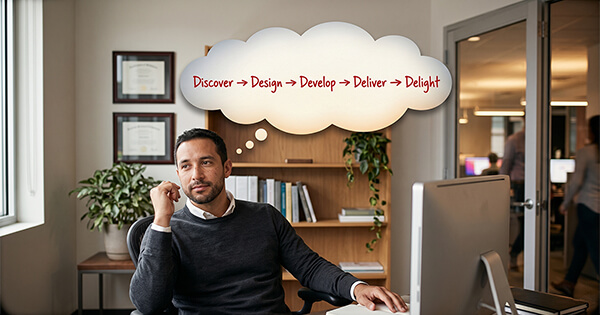
Neovation Custom Learning is your full-service, instant L&D capacity, providing expert instructional designers, eLearning developers, and project managers who turn your organization’s raw expertise into interactive, scalable custom training. Curriculum consulting is the front end of that work. Before anyone designs a screen, our team runs the needs analysis, talks to your subject matter experts, and produces the roadmap. That’s the Discover and Design portion of our Discover → Design → Develop → Deliver → Delight process, which can carry through to a finished program or stop at the plan if that’s all you need. Because the planning is scoped on its own through the Custom Learning Points model, you can start small and expand only if the build justifies it.
Curriculum consulting isn’t always the right call. If you already have a validated roadmap and approved outcomes, you can move straight to curriculum design services or development and skip the diagnosis. A narrow scope with internal bandwidth may need only a quick in-house needs analysis or a single experienced consultant, and off-the-shelf courses can cover generic topics. When the plan is what you’re missing, and you want to see how a roadmap becomes finished training, our case studies walk through that path, and you can contact us to talk through where your project stands.
Frequently asked questions
What does a curriculum consultant do?
A curriculum consultant plans training before it’s built. They run a needs analysis, define who the training is for and what it must teach, recommend the right mix of formats, and lay out how learning will be assessed. The result is a roadmap a design or development team can execute, rather than a finished course.
When should I hire a curriculum consultant?
Hire one when you know you need training but can’t yet describe the curriculum. The common triggers are knowledge stuck in a few experts’ heads, a leadership mandate with no roadmap behind it, or a backlog of overlapping courses no one has organized into a coherent path. If you can already specify what to build, you can usually skip consulting and go straight to design or development.
What’s the difference between curriculum consulting and curriculum design services?
Curriculum consulting produces the plan; curriculum design services produce the design. Consulting answers what training you need and in what order, ending in a roadmap. Design services take that roadmap and create the actual instructional materials (storyboards, learning flow, assessments) ready for development. Most organizations need consulting only when the plan itself is missing.
What do I get from a curriculum consulting engagement?
You get a curriculum roadmap: a document that specifies the learning outcomes, the sequence of courses, the recommended format for each, and the assessment plan. It’s built to be acted on, so you can hand it to an internal team, use it as the brief for a development partner, or build it in stages. Because it describes what to build, the plan stays useful no matter who does the building.
How much does curriculum consulting cost?
Curriculum consulting is scoped to the planning work (the needs analysis, personas, and roadmap), so it’s priced by the size of that effort and is usually a small share of the total training budget. Most of the spend goes to the development the roadmap leads to. Custom eLearning falls into three tiers anchored to a 15–20 minute module: basic content with simple text and visuals ($3,000–$6,000), mid-level with multimedia and interactivity ($6,000–$12,000), and advanced with simulations or branching scenarios ($12,000–$25,000), and a one-hour course typically runs 3–4 modules. A clear roadmap is what keeps that build from spending on the wrong things.