
Key takeaways
- eLearning content development creates the information that goes into a course: the on-screen text, the narration scripts, the scenarios, the case studies, and the source material. It’s distinct from instructional design (which decides what should be taught) and from course development (which builds the deliverable).
- The process runs through five overlapping phases: audience analysis, source material gathering, content drafting, scenario and example creation, and review. Each phase produces something the next phase uses, and shortchanging any of them shows up in the finished course.
- Subject Matter Expert (SME) interviews are the most common bottleneck. SMEs are usually busy, the work is time-sensitive when expertise is at risk of being lost, and most projects underestimate how much structure these conversations need.
- AI tools have become useful for drafting, summarizing, and rewriting content, but they don’t replace the design judgment that decides what should be taught or the SME accuracy review that determines whether the content is true. Treat AI as a research and drafting assistant, not a content developer.
- How much of the content work to handle internally versus with a partner depends on what’s already documented and what isn’t. Three common splits, from lightest involvement to heaviest, give buyers a clean way to think about scope before any vendor conversation.
In most eLearning projects, content development gets folded into either instructional design or course development — and the part that disappears in that conflation is the layer that decides whether a finished course actually teaches anything. Scenarios get written for plausibility instead of fidelity. The interviews that should surface tacit Subject Matter Expert (SME) knowledge skip past the questions that matter. Source material gets reused without the reconciliation it needs, and the finished course ends up polished, on-brand, and quietly off-target. Most projects don’t catch the gap in eLearning content development until the first round of learner outcomes comes back disappointing.
Content development is also the most labor-intensive phase of any custom project and the most often shortchanged when scope gets set. An early misjudgment compounds over the whole timeline.
This guide walks through what eLearning content development is, how the process actually runs, what the role looks like, where AI fits, how much of the work to handle internally versus with a partner, and how to tell good content development from mediocre.
What eLearning content development is
eLearning content development is the work of creating the words, scenarios, and source material that go into a training course. That covers the on-screen text, the narration scripts, the case studies, the practice questions, the references, and any other written or scripted material the learner will engage with. The output isn’t a finished course; it’s the raw material a course developer uses to build one.
The work sits between two adjacent disciplines that often get conflated with it:
- Instructional design decides what the training should be: the audience, the objectives, the structure, the practice opportunities, the assessment strategy. It produces a design or storyboard that tells everyone downstream what should exist.
- eLearning development takes the approved content and builds it into a working course. Authoring tool work, multimedia production, programming interactions, packaging for the LMS.
eLearning content development sits between them. Where the instructional design specifies a scenario about a customer-service edge case, the content developer writes the actual scenario. The course developer takes that finished scenario and builds it into a clickable interaction inside the authoring tool.
When teams collapse these three jobs into one role, the design work usually suffers first. A developer asked to do everything tends to default to the build work (which has visible deliverables and clear deadlines) and shortcut the content work (which is harder to measure and easier to skip). The result is courses that look polished and don’t actually teach.
The eLearning content development process
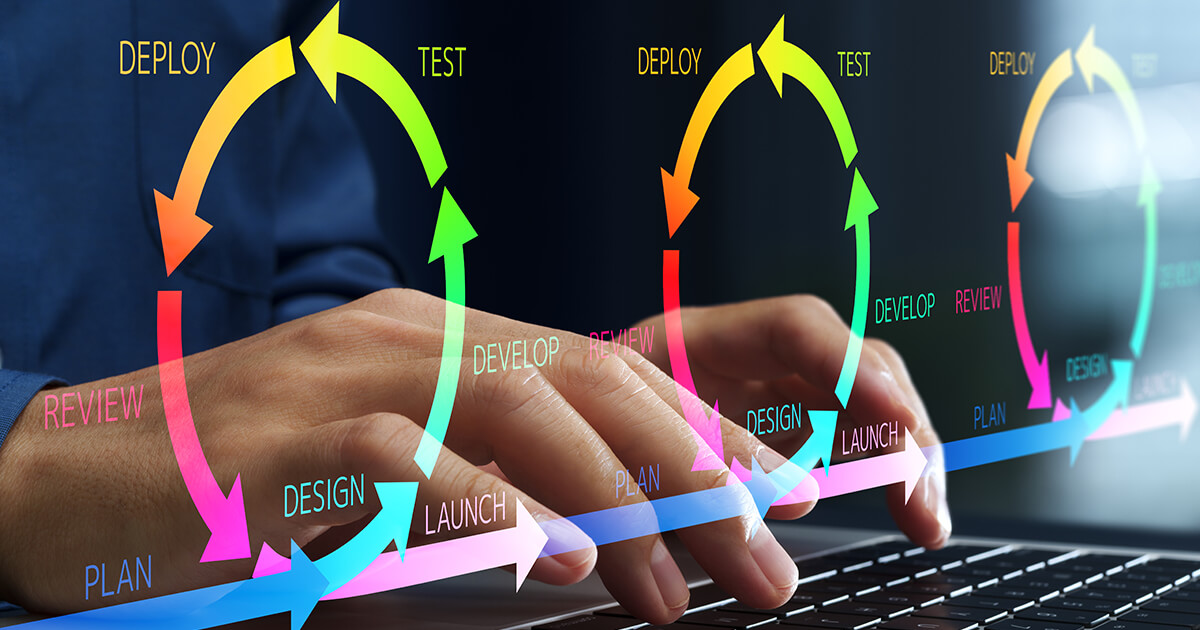
The process runs through five phases. They blur in practice (content developers iterate across them rather than treating each as a strict gate), but the underlying logic holds.
Phase 1: Audience analysis
Audience analysis comes before writing. The work in this phase is understanding who the content is for: what they already know, what they need to be able to do, what language and examples will resonate with their actual context, and what level of complexity is appropriate.
This is the part most rushed projects skip. Skipping it produces content that’s accurate, polished, and aimed at the wrong audience, which is the most common failure mode in eLearning content development.
Phase 2: Source material gathering
Most eLearning content doesn’t get written from scratch. It gets developed from existing source material: policies, SOPs, recorded webinars, training manuals, slide decks, internal documentation, and the institutional knowledge of subject matter experts. The content developer’s first real production task is pulling that source material together and figuring out what’s usable, what’s outdated, what’s missing, and what contradicts itself.
This phase often surfaces uncomfortable findings. Source material that everyone assumed was current turns out to be three versions behind the actual procedure. Two SMEs have different versions of the same process. A critical step exists only in someone’s head and was never written down. Better to find these things now than during review.
Phase 3: SME interviews and knowledge capture
Where the source material has gaps, the content developer fills them through SME interviews. The job is structured knowledge extraction: drawing out what experts know, getting it into teachable form, and validating it before it goes into the course.
SME interviews are the most common bottleneck in eLearning content development. SMEs are usually busy. Their availability is unpredictable. The work is time-sensitive when the SME is approaching retirement or transitioning out of a role. And most teams underestimate how much structure these conversations need to be productive.
A good content developer doesn’t just record SME conversations and transcribe them. They run the interview as a focused extraction process: asking the questions that surface tacit knowledge, pushing past surface-level explanations to find the underlying decision logic, and (often the hardest part) translating expert vocabulary into terms the actual learner will recognize.
Phase 4: Content drafting and scenario creation
The drafting phase produces the actual written content: the on-screen text, the narration scripts, the scenarios, the case studies, the practice questions, the assessment items. This is where the design from upstream meets the source material from earlier phases.
The work is writing for a specific learning context. Each piece of content has to do a specific job: introduce a concept, demonstrate an application, give the learner a chance to practice, check whether they got it. Content that doesn’t have a clear job in the design tends to get cut or reworked during review.
Phase 5: Review and revision
The final phase is review by stakeholders, SMEs, and (often) legal or compliance reviewers. Each reviewer has a different job: stakeholders check that the content meets the project’s goals, SMEs check accuracy, legal checks for risk. The content developer’s job during review is consolidating the feedback (which often conflicts), revising the content, and shipping a final version that everyone approves.
Review cycles take longer than first-time buyers expect. A typical content development project has at least two formal rounds of review, each lasting five to ten business days. Compressing review usually means shipping content that hasn’t been validated, which surfaces problems later and is much more expensive to fix at that stage.
What an eLearning content developer does
The eLearning content developer’s day-to-day work falls into a few overlapping areas. The mix varies by project and team, but most content developers spend their time on a combination of:
- Interviewing SMEs and structuring what they say into teachable form.
- Reading and synthesizing source material (manuals, policies, recordings, prior training).
- Writing on-screen text, narration scripts, and assessment items.
- Drafting scenarios, case studies, and other applied-practice content.
- Working with instructional designers to align content with the storyboard.
- Coordinating review cycles and consolidating feedback from multiple stakeholders.
- Revising drafts based on review and shipping final content to course developers.
The role overlaps with adjacent functions in ways that vary by team. Some teams have separate writers, instructional designers, and editors. Others expect the content developer to handle all of those tasks. Both work; the trade-off is between range and depth.
A common confusion: “eLearning content developer” sometimes gets used as a synonym for “eLearning developer” (the person who builds courses in authoring tools). The two roles are distinct. Content developers create the words and scenarios; eLearning developers build the course inside Articulate Storyline, Rise, or similar tools. Most projects need both.
Where AI fits in eLearning content development
AI tools have become useful in this work over the last few years. They’re now a standard part of most content developers’ toolkits, but the framing matters: AI accelerates parts of the production work, not the design judgment that decides what should be taught or the SME accuracy review that determines whether the content is true.
The places AI helps:
- Drafting: First-draft generation of on-screen text, narration scripts, and scenario outlines. The output usually needs significant revision, but starting from a draft is faster than starting from a blank page.
- Variant generation: Producing multiple versions of the same scenario, question stem, or example so the developer can pick the strongest. Variant work is tedious to do by hand and well-suited to AI.
- Summarization: Pulling key points from source material (long policies, transcripts, recordings) into formats the developer can work with.
- Rewriting: Adjusting tone, simplifying language, shortening passages, or rewriting for a different audience.
The places AI doesn’t help, and where leaning on it produces unusable content:
- Deciding what should be taught. That’s design judgment, and AI doesn’t have your audience, your goals, or your operating context.
- Verifying accuracy. AI output is plausible by default; plausibility and accuracy are different things. Anywhere the content asserts how a process actually works, an SME has to confirm.
- Capturing what an expert knows. SME interviews surface tacit knowledge that doesn’t exist in any document AI has access to.
A useful working frame: AI does the kind of drafting work a junior content developer would do. A senior content developer does the work AI can’t, which is where most of the actual value lives. Our piece on AI-generated content vs AI-assisted instructional design goes deeper on the distinction.
How much of the content work to handle internally versus with a partner
The decision about what to keep internal and what to bring in help for usually comes down to one question: how much of the content work has already been done before the project starts? Three common splits cover most situations.
| Level of partner involvement | What you have going in | What the partner does | Best for | Custom Learning tier |
|---|---|---|---|---|
| Light | A finished, fully written storyboard | Reviews the storyboard before development and provides notes back to your team | Internal teams with strong content development skills who want a second set of eyes | Level 1: Content Review |
| Moderate | Slide-ready content with all the words written, but no interactivity or eLearning design | Transforms finished content into interactive eLearning (knowledge checks, learner instructions, engagement layer) | Organizations with strong internal writers but limited eLearning design experience | Level 2: Content Editing |
| Heavy | Source documents, SMEs with expertise in their heads, a goal, but no organized content yet | Runs SME interviews, reconciles source material, drafts content, creates scenarios and assessments, produces a finished storyboard | Projects with at-risk knowledge, complex regulatory content, or material that hasn’t been organized into teachable form before | Level 3: Content Production and Storyboarding |
Light involvement: you’ve done the content work, you want a quality check
If your team has produced a finished, fully written storyboard with all content in place (narration scripts, scenarios, assessments, the lot), the help you need is a professional review before development starts. A content reviewer goes through the storyboard for inconsistencies, instructional flow issues, terminology, and learning-objective alignment, and provides notes. Your team makes the edits.
This is the lightest level of partner involvement. Best for internal teams with strong content development skills who want a second set of eyes before committing to the build.
In Neovation Custom Learning’s tiering, this is Level 1: Content Review.
Moderate involvement: you’ve written the content, you need it transformed into eLearning
If your team has produced complete, slide-ready content (the instructional flow worked out, all the words written, narration scripts in place) but you don’t have the design and development expertise to turn it into actual interactive eLearning, the help you need sits between editing and full development. The partner takes your finished content and adds the interactive elements, knowledge checks, learner instructions, and engagement layer that make it work as eLearning.
This is the middle level of partner involvement. The instructional structure stays yours; the transformation into eLearning becomes the partner’s job. Best for organizations with strong internal subject matter writers but limited eLearning design experience.
In Custom Learning’s tiering, this is Level 2: Content Editing.
Heavy involvement: you have raw material, you need full content development
If your team has source documents, SMEs with expertise in their heads, and a goal but no organized content yet, the help you need is full content development. The partner runs SME interviews, gathers and reconciles source material, drafts the content from scratch, creates scenarios and assessments, and produces a fully developed storyboard ready for course development.
This is the heaviest level of partner involvement and the most common scope when the topic involves at-risk knowledge, complex regulatory content, or material that hasn’t been organized into teachable form before.
In Custom Learning’s tiering, this is Level 3: Content Production and Storyboarding.
The right split depends on what you have and what you’re missing. Most organizations end up using different levels for different projects rather than committing to one level across the board.
How to tell good eLearning content development from mediocre
The hardest part of evaluating content development is that mediocre work often reads fine on first inspection. The grammar is correct, the tone is appropriate, the visuals are on-brand. The differences show up later, in places most stakeholders aren’t watching.
Some signals that content development is actually good:
- The content has a clear job at every point: Each section, scenario, and assessment has a specific purpose tied to a specific learning objective. Content that exists “for engagement” without serving an objective is a sign the design work was rushed.
- Scenarios feel like the actual workplace, not a generic example: Mediocre scenarios are abstractly correct. Good scenarios sound like something a learner would actually face on Tuesday morning.
- SME accuracy holds up under scrutiny: Specific numbers, policy details, and procedural steps match what’s actually true in your organization. Plausibility is not the same as accuracy.
- Tone fits the audience: Mediocre content reads at the wrong register: too formal for a frontline audience, too casual for a regulatory one. Good content sounds like the learner’s actual context.
- The content is reusable and updatable: Source files are clean, references are documented, and an updater six months from now can find what they need to revise the content without rebuilding from scratch.
How Custom Learning approaches eLearning content development
Neovation Custom Learning is your full-service, instant L&D capacity, providing expert instructional designers, eLearning developers, and project managers who turn your organization’s raw expertise into interactive, scalable custom training.
Custom Learning’s instructional designers and content developers are full-time employees who’ve worked together on hundreds of projects. The team handles all three levels of content involvement (review, editing, and full development) with the same people across the same engagement model.
What this looks like in practice depends on the project. A finished storyboard might come in for a Level 1 review only. Slide-ready content from an internal team often arrives needing the Level 2 transformation into interactive eLearning. And on projects where the topic lives mostly in source documents and SMEs’ heads, Level 3 content development runs from the ground up. We scope to what the project actually needs rather than defaulting to one level, and content development is typically scoped alongside the custom eLearning build it feeds into.
We use AI tools as part of our content development workflow (for drafting, variant generation, and rewriting), but the design judgment, the SME interviews, and the accuracy review stay with the human team. AI accelerates production; it doesn’t replace the work that makes training actually teach.
Source files are included with every delivery, so your team can update content internally rather than coming back to us for every revision. The standard 30-day warranty covers bug fixes and minor adjustments; extended support is available when ongoing maintenance fits your needs.
For the vendor-evaluation view of this work, see our guide to evaluating eLearning content development companies, which covers the six kinds of vendor that share the search results and how to tell content depth from slide reskinning.
If your situation looks like a fit, we’d be glad to talk. If it doesn’t, we’ll point you toward what does — narrow-scope projects often go better with a freelancer, regulated content typically needs a specialty shop with the right industry background, and for plenty of teams the best answer is keeping most of the work internal with external help layered in at specific checkpoints. The right call depends on what’s already in place and where the gaps actually are. Contact us when you’re ready, or browse our case studies to see how this looks across different industries and project sizes.
Frequently asked questions
What is eLearning content development in simple terms?
eLearning content development is the work of creating the words, scenarios, scripts, and source material that go into a training course. It sits between instructional design (which decides what should be taught) and course development (which builds the finished deliverable). Most projects need all three, often handled by different specialists working together.
What’s the difference between eLearning content development and instructional design?
Instructional design decides what the training should be: the audience, objectives, structure, and practice. eLearning content development is the work of creating the actual words and scenarios that fit that design. Designers work at the level of "this section needs a decision-based scenario about scope creep." Content developers write the scenario.
How long does eLearning content development take?
It depends heavily on what already exists. A project with finished storyboards needing only a content review might take a week or two. A project with slide-ready content needing transformation into interactive eLearning typically runs three to six weeks. Full content development from raw source material and SME interviews can take six to twelve weeks for a single course, longer for multi-module programs.
How much does eLearning content development cost?
Content development pricing is usually quoted as part of full module or course pricing rather than as a standalone line item. Custom eLearning modules fall into three tiers based on complexity, anchored to a typical 15–20 minute module: basic content with simple text and visuals ($3,000–$6,000), mid-level with multimedia and interactivity ($6,000–$12,000), and advanced with simulations or branching scenarios ($12,000–$25,000). A typical one-hour course contains three to four modules, so course-level pricing scales accordingly. Heavier content engagements (full Level 3 work with SME interviews and source reconciliation) sit toward the upper end of each tier because the content layer is where most of the per-module labor lives.
How do I develop eLearning content?
The standard process runs through five phases: audience analysis (understanding who the content is for), source material gathering (pulling together what already exists), SME interviews (filling the gaps), content drafting (writing the actual words and scenarios), and review (validating with stakeholders and SMEs). Each phase produces something the next phase uses. Shortcutting any of them shows up in the finished course later.
Can AI develop eLearning content?
AI tools can draft, summarize, vary, and rewrite content effectively. They can’t decide what should be taught, verify whether content is accurate against your real operating context, or extract tacit knowledge from a Subject Matter Expert. The right model is AI as a research and drafting assistant inside a designed workflow, with the design judgment and SME validation staying human.
Should I develop eLearning content internally or use a partner?
It depends on what’s already documented and what isn’t. If your content is finished and you want a quality check, internal development plus a partner review usually works well. If your team has slide-ready content but limited eLearning experience, a partner can transform it into interactive eLearning while the structure stays yours. If your content lives in source documents and SME heads with no organized teachable form, a partner running full content development is usually faster and better than internal staff stretching outside their core skills.